
The Big Five is the most extensively tested model in personality science. Here’s what its five traits measure, why researchers trust it, and how our own framework maps the same territory.
What’s Coming Up
- Key Takeaways
- The Science Behind 16Personalities’ Free Test
- Where the Big Five Comes From
- The Big Five Personality Traits, Explained
- Why Scientists Trust the Big Five
- How 16Personalities Relates to the Big Five
- What This Means for Your Personality Type
- Frequently Asked Questions
- Further Reading
Key Takeaways
- The Big Five is the most widely accepted model of personality in modern psychology. Its five traits emerged from decades of independent research rather than from any single theorist’s ideas.
- The five traits are Openness, Conscientiousness, Extraversion, Agreeableness, and Neuroticism. Each one is a scale, so a person scores higher or lower on it instead of being boxed into a fixed type.
- Researchers trust the Big Five because its core structure reappears across cultures, languages, and decades of studies. It also predicts meaningful life outcomes, from work habits to well-being.
- The 16Personalities framework measures five trait spectrums that are similar to the Big Five. These come from our own research, and translate each dimension into accessible language paired with a familiar type-based format.
The Science Behind 16Personalities’ Free Test
Personality psychology has produced plenty of competing theories over the past century, but only one model has earned something close to universal legitimacy among researchers: the Big Five.
If you’ve ever taken our free personality test and wondered what’s under the hood, this is it. Even though we’ve made some adjustments to this foundational framework, understanding the Big Five means understanding the science behind your 16Personalities results – and why we built our model the way we did.
Where the Big Five Comes From
No one person invented the Big Five. The model took shape over several decades, as separate research teams kept arriving at the same five patterns in their data.
The story starts with a simple idea called the lexical hypothesis – if a personality difference matters in human life, people will have coined words for it. In 1936, psychologists Gordon Allport and Henry Odbert combed an English dictionary and cataloged roughly 18,000 words that describe people. Over the following decades, researchers used a statistical technique called factor analysis to boil that enormous vocabulary down to its underlying patterns.
The same result kept surfacing. When people rate themselves or others on large sets of descriptive words, the ratings cluster into five broad groups. Ernest Tupes and Raymond Christal found the pattern in 1961, and Lewis Goldberg demonstrated its existence so thoroughly in his landmark 1990 study that he gave the model its name – the Big Five. Working separately with questionnaires rather than word lists, researchers Paul Costa and Robert McCrae arrived at essentially the same five dimensions.
When multiple studies keep landing on the same five factors, it’s a strong sign the pattern reflects something real about human nature rather than any single researcher’s theory.
The Big Five Personality Traits, Explained
The Big Five, more formally known as the five-factor model, describes personality along five continuous dimensions. Psychology students often learn them with the acronym OCEAN.
Openness to Experience
Openness describes how drawn someone is to novelty, ideas, and imagination. People high in this personality trait gravitate toward abstract thinking, art, and unconventional possibilities. People lower in Openness prefer the concrete and the familiar – they’d rather perfect what works than chase what might.
Conscientiousness
Conscientiousness captures self-discipline, organization, and follow-through. Someone high in this trait makes plans and actually keeps them. Someone lower in this trait works in bursts, improvises, and treats deadlines as more of a suggestion than a contract.
Extraversion
Extraversion measures how much energy a person draws from external stimulation, especially social contact. High scorers seek out people, activity, and excitement. Low scorers – introverts, in Big Five terms – do their best work in quieter settings and need solitude to recharge.
Agreeableness
Agreeableness reflects how much someone prioritizes harmony and other people’s needs. High scorers are cooperative, trusting, and quick to empathize. Lower scorers are more competitive and skeptical, and they’ll choose to speak an uncomfortable truth over a comfortable silence.
Neuroticism
Neuroticism describes sensitivity to stress and negative emotion. People high in this trait feel worry, self-doubt, and frustration more readily and more intensely. People low in this trait have an easier time staying calm under pressure and tend to bounce back more quickly from setbacks.
Why Scientists Trust the Big Five
Plenty of personality frameworks sound convincing. But the Big Five has real authority earned through evidence that has held up under decades of scrutiny and challenges.
Another reason the five-factor structure is so trusted is that it appears across cultures and languages. In a well-known 1997 study, McCrae and Costa analyzed personality data from over 7,000 people across translations in German, Portuguese, Hebrew, Chinese, Korean, and Japanese. The same five traits emerged in every sample, leading the authors to argue that this personality structure is practically universal despite language and cultural differences.
The traits are also remarkably stable. Research summarized in the broader Big Five literature shows that individual scores stay fairly consistent across adulthood, shifting gradually rather than swinging wildly. And the model predicts real outcomes – Conscientiousness is one of psychology’s most reliable predictors of job performance, for example. Neuroticism scores are consistently related to stress and health.
The Big Five treats every trait as a scale, not an either/or switch. Nobody is completely extraverted or completely agreeable. Instead, everyone has some level of each trait, ranging from low to high.
How 16Personalities Relates to the Big Five
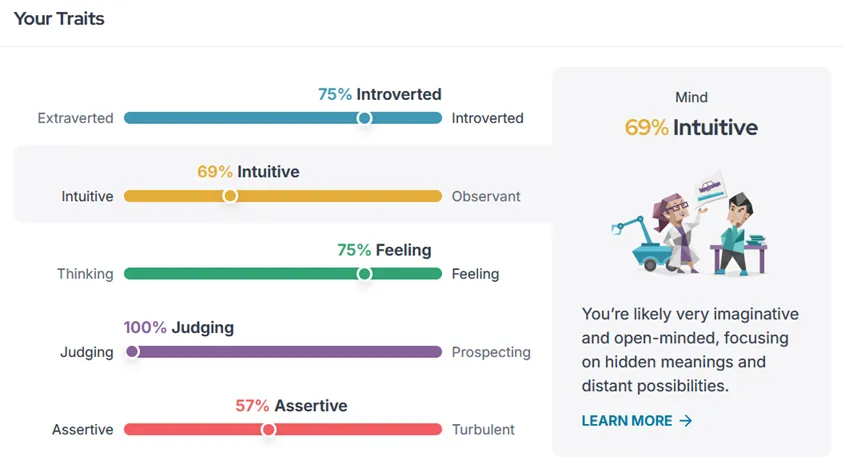
What’s interesting about personality psychology is how the field keeps arriving at the same destination. Whether researchers start from dictionaries, questionnaires, or behavioral observation, the data keeps organizing itself around a small set of core dimensions. How we engage with the world. How we process information. How we make decisions. How we approach structure and planning. How we experience stress and emotion.
The Big Five is the most rigorously documented demonstration of that convergence, which is why it anchors so much modern research. But the convergence itself is the deeper finding. These dimensions of personality are universal to human nature, and every serious framework is, in its own way, an attempt to measure them.
The 16Personalities framework is no different, and that’s by design. When we developed our model, we studied the full range of personality research, from the type theories of the early twentieth century to the trait models that dominate the field today. Then we built our own instrument to measure five personality trait spectrums, developed and validated independently, and refined continuously over more than a decade.
- Energy (Introverted vs. Extraverted) explores how you engage with the world around you and where you direct your mental energy.
- Mind (Intuitive vs. Observant) explores how you see the world and what kind of information you focus on.
- Nature (Thinking vs. Feeling) explores how you make decisions and cope with emotions.
- Tactics (Judging vs. Prospecting) explores your approach to work, planning, and decision-making.
- Identity (Assertive vs. Turbulent) explores how confident you are in your abilities and decisions, and how you respond to stress and setbacks.
Each of these covers ground that Big Five researchers would recognize, because both models are mapping the same underlying territory. But our traits are our own, developed and balanced through our own research. The biggest differences show up in how we present what they measure.
The Big Five gives you a higher or lower score on a single trait, which can make the low end sound less desirable. Our approach names both ends of each scale and treats them as equally valid. For example, instead of scoring someone as “high” or “low” on Neuroticism, we describe them as more Assertive or more Turbulent. Each reflects a different way of approaching life, with its own strengths and challenges.
None of that costs us any precision. The measurement stays scientifically precise, so a result like “you are 63% Extraverted” tells you exactly how strongly you lean toward any given trait. The most notable difference, however – and what makes 16Personalities so accessible – is how we combine your five measurements into a single personality type. This offers a shareable, memorable way to learn more about your personality without sacrificing the nuance found in your results.
What This Means for Your Personality Type
The next time you take our free personality test or revisit your personality profile, keep in mind that you’re not just reading a label. You’re reading five specific measurements of dimensions that psychologists have found again and again, in every culture they’ve studied, for nearly a century.
That’s the foundation we chose on purpose, because self-discovery is only possible when it’s nurtured by something you can fully trust. The personality type you’re assigned may be what you remember, but the five traits are what make it true.

Comments
No comments yet. Please to join the discussion.