
Their personality types have the same four letters, but very different foundations. Here’s how 16Personalities compares to the MBTI – and how our freakishly accurate personality profiles are made possible.

What’s Coming Up
- Key Takeaways
- Why Do MBTI and 16Personalities Look So Similar?
- What Is the Difference Between MBTI and 16Personalities?
- How Reliable and Valid Is the 16Personalities Test?
- Where Doubt Ends and Insights Begin
- Frequently Asked Questions
- Further Reading
Key Takeaways
- The Myers-Briggs Type Indicator® (MBTI®) and 16Personalities share the famous four-letter personality type format, but they are fundamentally different theories. The MBTI is rooted in Jungian cognitive functions, while the 16Personalities framework reworks the Big Five trait model that dominates modern personality research.
- 16Personalities measures five trait spectrums rather than four either-or categories. Its fifth scale – Identity – captures self-confidence and sensitivity to stress, something the MBTI does not assess.
- We openly publish the reliability and validity statistics for the NERIS Type Explorer®. Its scales meet accepted psychometric standards for internal consistency, stability over time, and independence from one another.
- The 16Personalities framework is built on the most validated trait model in psychology and tested across cultures. Taken more than 1.5 billion times in over 45 languages, it offers sample sizes and cross-cultural feedback that few paid assessments can match.
Why Do MBTI and 16Personalities Look So Similar?
Both MBTI and 16Personalities frameworks can seem similar because they share a common ancestor – Carl Jung’s theory of psychological types. In the 1920s, Katharine Cook Briggs and her daughter, Isabel Briggs Myers, began building on Jung’s ideas, eventually creating the MBTI and the four-letter acronyms that have since become cultural shorthand for personality itself.
16Personalities kept that acronym format deliberately. It’s simple, familiar, and easy to talk about – there’s a reason those letters show up in dating profiles and job interviews alike. Plenty of other systems, from Socionics to the Keirsey Temperament Sorter, borrowed the same convention.
Here’s the catch, though – identical letters don’t mean identical definitions. Each theory defines its acronyms in its own way. Five people who all claim the same four letters may be describing five completely different personality profiles, depending on which framework their result came from.
What Is the Difference Between MBTI and 16Personalities?
The MBTI and 16Personalities are two distinct, trademarked frameworks that both describe 16 personality types using four-letter codes – which is why they’re so often mistaken for each other. But they are not the same test, the same theory, or the same organization.
3 Key Differences Between MBTI and 16Personalities
The similarities between the MBTI and 16Personalities frameworks are mostly cosmetic. The differences run deeper – into the theory, the measurements of validity, and even the number of letters in your result. Here are the three differences that matter most.
1. We Use a Different Scientific Foundation
The MBTI remains grounded in Jungian concepts – particularly cognitive functions, the mental processes each personality type is said to prefer in a specific order. These ideas shaped the field, but over time, it became obvious that they are notoriously hard to measure and test scientifically.
The 16Personalities framework doesn’t use cognitive functions. Instead, it reworks the Big Five personality traits – the trait model that dominates modern psychological research. The familiar letters remain, but the science behind them is entirely different.
2. We Measure Spectrums, Not Boxes
Traditional type systems sort people into one of two boxes on each scale. The NERIS model treats every scale as a continuous spectrum and reports your position as a percentage:
- Introverted vs. Extraverted – whether you recharge in solitude or in company
- Intuitive vs. Observant – whether you focus on future possibilities or present realities
- Thinking vs. Feeling – whether logic or emotional harmony carries more weight in your decisions
- Judging vs. Prospecting – whether you prefer structure and closure or open options
- Assertive vs. Turbulent – how self-assured, even-tempered, and stress-resistant you are
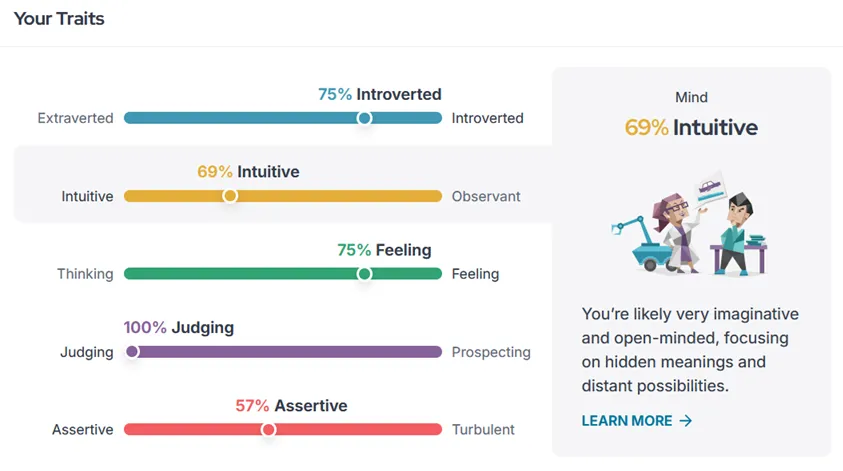
Someone who is 55% Extraverted moves through the world differently than someone who is 95% Extraverted. This is also why the Big Five dominates personality research – spectrums are far more accurate and nuanced than black-and-white boxes.
After taking our free personality test, you’ll see your exact position on all five trait scales. This allows you to know whether a given trait is a defining feature of your personality or a slight lean toward one side of the spectrum or the other.
But we don’t want you to walk away with nothing but a string of percentages. That’s why 16Personalities still assigns you a personality type. Stand-alone scores are easy to forget, but a clear, human description gives them meaning. People are far more likely to recognize themselves in a detailed personality profile than in a result like “75% Introverted, 69% Intuitive, 75% Feeling, 100% Judging, and 57% Assertive.”
The NERIS model combines the precision of a trait model with the memorability and usability of a type model.
3. We Assess 5 Scales
Every 16Personalities personality type result ends in -A or -T, and the MBTI has no equivalent. This fifth scale reflects how confident you are in your abilities and decisions. Assertive individuals (-A) tend to be even-tempered and resistant to worry, while Turbulent individuals (-T) tend to be self-conscious, perfectionistic, and eager to improve. This particular trait helps explain why two people with the same personality type may respond very differently to pressure, setbacks, uncertainty, and everyday challenges.
How Reliable and Valid Is the 16Personalities Test?
The published statistics show that the NERIS Type Explorer, our free personality test, is both reliable and valid, meeting accepted psychometric standards:
- Internal consistency: All five scales show Cronbach’s alpha values between 0.75 and 0.87 in a sample of 10,000 respondents – comfortably within the accepted 0.70–0.90 range. In plain terms, the questions within each scale work together reliably to measure the same aspect of personality.
- Test-retest reliability: When 2,900 respondents retook the assessment after a break of five to seven months, correlations ranged from 0.74 to 0.83 across the scales – above the accepted 0.70 threshold, despite the natural drift personality shows over time. In plain terms, people tend to receive similar results even when they retake the assessment months later.
- Discriminant validity: The five scales measure five distinct aspects of personality. The highest correlation between any two scales is just 0.37, far below the level that would suggest significant overlap. In plain terms, each scale captures something meaningfully different rather than measuring the same quality under a different name.
The full analysis is published openly in our Reliability and Validity article. Openness and accessibility is part of the 16Personalities method. And it goes without saying that an assessment taken more than 1.5 billion times in over 45 languages creates sample sizes and cross-cultural feedback that few paid tests can match. The people who have taken our personality test tend to agree – the assessment currently holds a 91.2% accuracy rating from test takers around the world.
Where Curiosity Meets Credibility
Nearly a century ago, the MBTI opened the world’s eyes to personality typing. 16Personalities carries that tradition forward with a framework built on the most validated trait model in psychology, showing that personality insights can be both grounded in research and genuinely engaging.
That combination is the whole point. Our framework has been tested across cultures and refined by feedback from a global community – and the result is an experience millions of people find informative, memorable, and easy to talk about.

Comments
No comments yet. Please to join the discussion.