
Nature: Thinking (T) vs. Feeling (F)

How to Think and Feel About the Thinking and Feeling Traits

Our third, Nature scale reveals the extent to which we value emotions or rationality more when considering options. Does a person tend to use the Thinking (T) personality trait, which relies on the head, or the Feeling (F) trait, which relies on the heart?

But let’s not oversimplify. Think of it instead as you might your hand preference: A left-handed person leans more heavily on their left hand, but they still use their right hand, albeit less. We can apply the same approach to a person with a dominant Thinking trait or a dominant Feeling trait – they aren’t without some qualities of the non-dominant trait.

What about you?

What about you?

Free

Only 10 minutes to get a “freakishly accurate” description of who you are and why you do things the way you do.

Take the Test

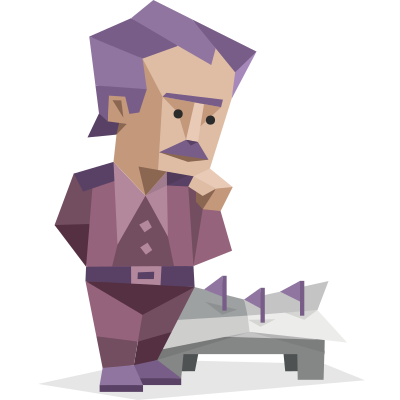
Thinking (T) Personality

“How Does This Help?”

83% of people with the Thinking trait say it’s best to take a scientific approach to the problems in their own lives, compared to 43% of those with the Feeling trait.

When presented with a decision, people with the Thinking trait typically lean on objective information. Knowledge is their indispensable tool. Once these personality types gather the facts, they test their alternatives against logic and reason to see which decision, by those standards, proves the most effective or realistic. They generally manage their relationships by employing fairness and effectiveness as their primary method of dealing with others. Their passions are born of respect.

74% of people with the Thinking trait say it’s easy for them to make important decisions without consulting with someone else first, compared to 42% of those with the Feeling trait.

Whatever value people with the Thinking personality trait place on relationships, they can still dismiss emotional responses, either their own or those of others. This is often because of their discomfort with emotions, which don’t always follow the rational path they value. Sometimes, emotions just puzzle them. But that doesn’t mean they have hearts of stone. They often feel in deep, profound ways – they would just rather not decide matters from that place. And, perhaps unfortunately, they may see those who do as weaker decision-makers.

People with the Thinking personality trait can use rational thought to see that humans are inherently emotional – and that this is okay.

Personality types with the Thinking trait are likely to evaluate things almost relentlessly. This isn’t as bad as it sounds. They aren’t satisfied if they believe something is not well thought out – they revel in the brilliance of an elegant plan. This makes them great to have around when critical thinking and impartiality of any kind is the focus, and this makes them immensely helpful for sorting out ideas and methods. Their primary filter is, “How does this help?”

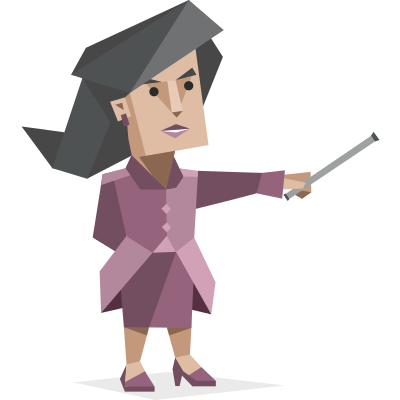
Feeling (F) Personality

“Who Does This Help?”

88% of those with the Feeling trait said they value and cherish their emotions, compared to 47% of those with the Thinking trait.

People with the Feeling (F) trait follow their hearts and emotions – sometimes without even realizing it. They may show it to different degrees and in different ways, but however they do it, Feeling personality types tend to be caring, compassionate, and warm. These concerned people can be highly protective of those they care about – whether that is their immediate family or remote populations in need.

For those with the Feeling trait, decisions tend to be based on the well-being of others.

However, people with the Feeling personality trait often find they become excessive in their concern for others. They may easily burn out – or cause others to – when they become too involved. These emotionally aware individuals can become depressed if they feel they haven’t been as selfless in life as they imagine they should be, or if those they have helped seem to fall down regardless.

65% of those with the Feeling trait say they mostly listen to their hearts when they make important choices, compared to 7% of those with the Thinking trait.

Feeling personality types’ concern for others typically affects all their endeavors. This can be practical and close, as with family, friends, and colleagues. Or it can be broader, as with world peace, ending hunger, and giving the disadvantaged a boost.

But this reliance on feelings doesn’t mean there is no logic – theirs is just a different logic. They see that emotions can’t simply be waved away, so feelings and the welfare of others shape their lives more than stark facts and cold objectivity. Weighing things this way makes these personalities valuable to have around when the big question is, “Who does this help?”

Comments

Please to join the discussion.

ENTP avatar
This is pretty cool. I am 81% thinking and have never understood how people let their emotions guide them so much. I'm horrible with emotional support and usually don't get along well with emotional people, so seeing that a lot of people are the same is reassuring.
A grayscale avatar for an anonymous user
I just don't understand: How can people not weigh the pros and cons when making important decisions?
A grayscale avatar for an anonymous user
See, what I do is this: If I don’t think my action will affect people negatively, then I go in reason and thought. However, if it genuinely affects people’s lives then I can’t ignore that and have to go with what’s best. Yes, it can be a pain. But I know that it’s for good, so I don’t mind.
A grayscale avatar for an anonymous user
You're right but ı think we must look from other side to us maybe someone think us like that "How can a people be inutitive?"
INTJ avatar
My default mode of thinking if something is logical and right it should be done regardless of feelings . I am used to override my own strong feelings all the time Having said that I admit it was not best approach at times. Especially in relationships
ESFP avatar
As a feeler, I often help others a lot, and sometimes I can ignore my own feelings, so this makes sense! I get so emotional sometimes...
A grayscale avatar for an anonymous user
yep
A grayscale avatar for an anonymous user
I'm a feeler by 83%, and this is true. I feel so much it makes me wanna bake a cake of rainbows and smiles and I wish we could all eat it and be happy. That's from mean girls, if you know what I mean.
A grayscale avatar for an anonymous user
Haha lol I know what you're talking about. "SHE DOESN'T EVEN GO HERE"
A grayscale avatar for an anonymous user
As an INTP, seeing that only 43% of people with the Feeling trait agreeing that it's better to take a scientific approach to problems in one's life is shocking; I mean, if I had the Feeling trait, I'd probably be shocked that 47% of people with the Thinking trait value and cherish emotions
A grayscale avatar for an anonymous user
I think we’re just extremely different. It’s not like we never make decisions based on facts and logic. It’s just that, more often than not, we make them with our hearts. I mean, I think I understand why thinkers generally don’t like feelings. They just get in the way of facts and alter decision making. Making choices based on feelings can be a pain, but I like doing it because I know that it’s better for me and others.
A grayscale avatar for an anonymous user
I do understand that it's not that Feelers don't ever make choices based on facts (I know a lot of Feelers that do) and I understand for you, it makes sense. 16Personalities even stated that those with the Feeling trait do use logic, just a different logic. I agree, Thinking/Feeling is kind of a polar opposite. For me as a Thinker, sometimes I do think about how my choice would affect people/going with what my gut says but not as frequently as a Feeler might. It's not a first thought for me.