
Core Theory

Introverted vs. Extraverted Personality Traits

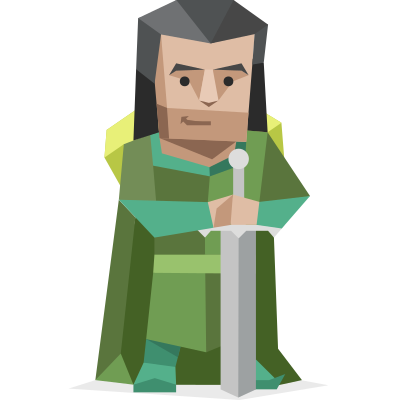
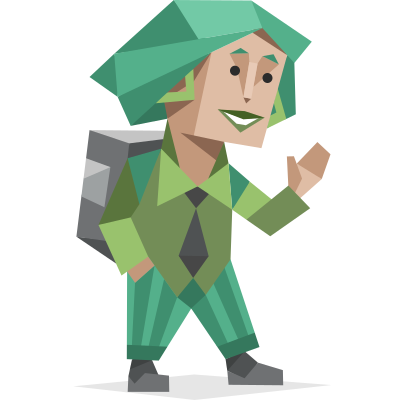
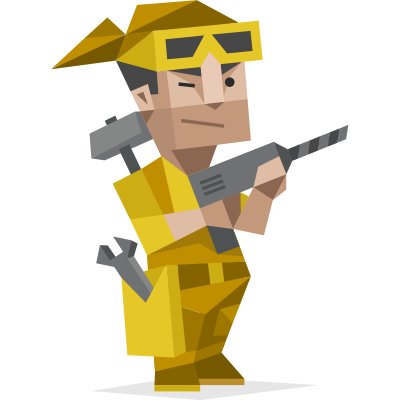
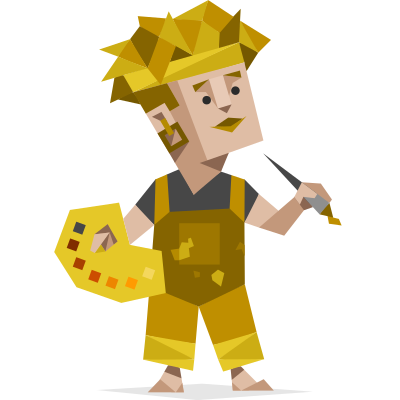
Introverted personality types in quiet solitude alongside Extraverted types in social engagement
The Energy scale includes the Introverted (I) and Extraverted (E) traits. This aspect of your personality type reveals whether you recharge alone or with others, but that’s only part of it.

Key Takeaways

  • Introversion and Extraversion affect how people respond to their environment and manage their mental and physical energy.
  • Introverts tend to find stimulation overwhelming and restore energy through solitude and reflection.
  • Extraverts thrive on stimulation and gain energy through engagement with the outside world.
  • Neither trait is superior. Both Introverted and Extraverted personalities bring unique strengths to different situations.
  • Understanding your position on the Introverted-Extraverted spectrum can help you manage your energy and interactions more effectively.

What Does It Mean to Be Introverted vs. Extraverted?

Many people assume that Introverts are shy and Extraverts are outgoing, but there’s much more to these personality traits than how social someone is.

The definition of Introvert is not just being quiet, just as the definition of Extravert is not being loud. At their core, the Introverted vs. Extraverted personality traits describe how we respond to our surroundings and get our energy. This key part of personality shapes how we interact with others, process information, respond to stimulation, and recharge our mental and physical reserves.

While some people show strong Introversion or Extraversion, most people fall somewhere in the middle of this spectrum. Many show a mix of both traits, adjusting their response to different situations in a balanced way. This flexibility allows for different expressions of individual personality types.

Introverted vs. Extraverted Personality Traits: Key Differences

Think of Introverted vs. Extraverted personality traits as two approaches to engaging with the world. If you’re an Introvert, you often direct your attention and energy inward, experiencing life through observations and reflections. If you’re an Extravert, your focus tends to be more outward, on actively engaging with people and your environment.

Here are a few common behaviors associated with the Introverted vs. Extraverted personality traits:

Introverted PersonalitiesExtraverted Personalities
Prefer deep conversations with few peopleEnjoy wide social networks and group activities
Process thoughts internally before speakingThink out loud and process verbally
More sensitive to external stimulationHigher threshold for external stimulation
Need quiet time to rechargeFeel restless when alone too long
Maintain a smaller, closer circle of relationshipsBuild extensive networks of acquaintances and friends

These differences in energy management can greatly affect daily life. Where you fall on the Introverted vs. Extraverted spectrum influences your interests and well-being in all areas. This holds true when you organize your social calendar, plan work projects, or decide how to spend a free evening.

Are you Introverted or Extraverted?

Take our free personality test to find out!

Take the free test

What It Means to Be an Introvert

Introverted personality types: INTJ (Architect), INTP (Logician), INFJ (Advocate), INFP (Mediator), ISTJ (Logistician), ISFJ (Defender), ISTP (Virtuoso), and ISFP (Adventurer).

How Introverts Respond to Their Environment

Introverts have a remarkable capacity for depth in their thoughts and their relationships. Their reserved nature comes from a natural orientation toward a rich inner world that others might never glimpse. This thoughtful approach often makes Introverts excellent listeners and observers, catching subtleties that many people miss in their rush to respond.

86% of Introverts say that, in general, they prefer to act anonymously if they can, compared to 48% of Extraverts.

“Anonymity” survey

A common sign of Introversion is being sensitive to noise, crowds, or even bright lighting. These things can deplete an Introvert’s mental energy reserves faster than even they may expect. This sensitivity isn’t a weakness – it’s often paired with an exceptional attentiveness to their environment that lets them notice details and nuance. The trade-off? Prolonged exposure to high-stimulation environments can leave them feeling drained. Seeking some “down time” to recharge is a common and healthy habit for people with a strongly Introverted personality.

This need for solitude isn’t about social anxiety or disliking people – it’s about energy management. Quiet, uninterrupted time helps Introverted personalities process experiences, reflect on ideas, and restore their mental reserves. Many Introverts describe this alone time as rich and fulfilling, rather than empty or lonely.

Understanding Introverts’ Relationships

Introverts often take a deep approach to relationships, from friendships to romance. They may feel the pull to be social, but they’re naturally choosy about their relationships and careful about who they spend time with. They often prefer meaningful one-on-one time more than large group settings, and they need to balance socializing with adequate recovery time.

86% of Introverts say they usually stay farther away from the action at parties and similar events, compared to 22% of Extraverts.

“Social Activities” survey

While Introverts may have smaller social circles than Extraverts, they often build deep, lasting connections. These personalities value quality over quantity in both friendships and romantic relationships, and they take their time to build a sense of trust before fully opening up to new people.

Introverts’ focus on social depth also shapes their work relationships and careers. Ideal jobs for Introverted personalities usually involve working alone or with small teams. The way that Introverts take time to think before speaking often leads to valuable input in group discussions, though it can also make it hard to jump into fast-moving conversations. Practicing strategically claiming space with something as basic as a request to speak or a raised hand is often beneficial for these personalities.

What It Means to Be an Extravert

Extraverted personality types: ENTJ (Commander), ENTP (Debater), ENFJ (Protagonist), ENFP (Campaigner), ESTJ (Executive), ESFJ (Consul), ESTP (Entrepreneur), and ESFP (Entertainer).

How Extraverts Engage with the World

Extraverts get energy from the world around them and enjoy outside stimulation – they’re not merely “talkative” or “sociable.” A common sign of Extraversion is a natural love for interaction that can energize not just themselves but others too. Extraverts have a tendency to process ideas outwardly and step into action, which helps make them effective when quick responses are needed.

68% of Extraverts say a fun social event is just what they need after a long and exhausting week, compared to 10% of Introverts.

“Social Activities” survey

For Extraverts, spending too much time alone or inactive can feel unsatisfying rather than refreshing. These personalities often work through thoughts by speaking them out loud, using conversation to develop ideas and refine their thinking. This verbal processing can make them seem quick-thinking and spontaneous, though they’re simply using the outside world as their mental workspace.

Extraverts usually have a high tolerance for stimulation, helping them do well in settings that might be too much for more Introverted personality types. Busy offices, lively gatherings, or fast-moving activities provide the level of engagement that helps Extraverts feel energized and focused. However, they also benefit from occasionally contrasting their high-energy habits with calmer, slower styles of engagement. This balance can open up new options for Extraverts – and provide for happy relationships with friends, loved ones, and coworkers of all personality types.

How Extraverts Thrive on Social Connection

Extraverts build broad social networks and enjoy group activities with lots of interaction. They start conversations easily, which makes them skilled at networking and community building. This outgoing nature serves them well romantically, too, as they create many chances to meet potential partners through their willingness to engage.

Extraverted personalities are doers by nature. They often move into new experiences and learn by doing rather than spending too much time thinking first. This makes them relatively comfortable with risk and quick to make decisions, though sometimes without enough detailed thought beforehand. For many Extraverts, the process of maturing includes learning to “think before they leap,” making their exciting lives safer and more successful.

88% of Extraverts say they believe that they have what it takes to be a good leader, compared to 52% of Introverts.

“Ambition” survey

In their careers, Extraverts do well in jobs that involve teamwork, presentations, and active tasks. Ideal jobs for Extraverts are dynamic. The Extraverted habit of thinking out loud can make people with this personality trait valuable during brainstorming and team discussions. However, they may lack patience for slower, more careful approaches and voices. Finding ways to give quieter colleagues enough room to contribute is a great way for Extraverts to discover all their options.

Being outgoing doesn’t mean that Extraverts never think deeply – many of these personalities do reflect thoroughly on important matters. The key difference is in how they process information and recharge: through connection with the outside world more than through quiet contemplation.

Is It Better to Be an Introvert or an Extravert?

There is no better trait because they’re part of a spectrum that includes us all. Understanding the Introverted vs. Extraverted personality traits gives you valuable insights into yourself and the people around you. Rather than seeing either trait as superior, you can recognize them as equally valid ways to manage energy and engage with the world.

If you’re an Introvert, acknowledging your need for calmer environments can help you manage your limits and flourish in a world full of Extraverted expectations. If you’re an Extravert, you can see your need for action and interaction as a normal part of your personality, not as a flaw. Both approaches have their place and their power.

The complementary strengths of Introverted and Extraverted personalities bring unique benefits to relationships, workplaces, and communities. Introverts offer depth, reflection, and careful listening, while Extraverts contribute enthusiasm, initiative, and social energy. Honoring both approaches allows every personality to exist and contribute in their own way. Understanding your core personality traits is an important beginning to fully understanding yourself.


Share this article
Support staff icon with a speech bubble.

Discover your personality type

Join over 1 billion people and take our free personality test to learn where you fall on this trait scale. It only takes 10 minutes and it has a 91.2% accuracy rating.

Take the test

Explore all personality types

Comments

Please to join the discussion.

INFJ (Advocate) personality type illustrated as a woman with green hair wearing a headband, with a gentle facial expression.
I'm an introvert and I love, love, LOVE spending time alone, but the weird thing is, I also love being a leader, organizing the group and figuring out what each person needs to do, I always instinctively take the leadership role, even if there isn't one. I love spending time with the people I love, but what i avoid at all costs is interacting with people i don't know and making new friends. I don't think i've seen someone like me who is introverted but loves being a leader. But, here's the catch: I only lead in things i know i'm good at or are passionate about. I guess that makes sense, since i'm an infj. I hope i make sense. lol excuse my grammar mistakes.
A grayscale avatar for an anonymous user
What you said, is just like me
A grayscale avatar for an anonymous user
Yes! This is me. I am the oldest of ten kids, so naturally I am a leader. I am in my element as a leader at home. However, in school settings, I rarely take charge because I feel like someone else could do it better than me.
A grayscale avatar for an anonymous user
I would be happy to spend the rest of my life on a deserted island. As long as I had a steady food and water supply. Then my anxiety would almost be nonexistent. And that would make it all worth while.
INFP (Mediator) personality type illustrated in a portrait style.
Similar except I would probobly need my bestie so I don't get bored.
A grayscale avatar for an anonymous user
I would HATE being alone on a deserted island, even if it was beautiful and scenic! I MUCH prefer the company of others and I avoid being alone most of the time. I just love people too much to be satisfied on a desert island!
A grayscale avatar for an anonymous user
I could NEVER be alone on a desert island! I would feel way too lonely !!! Even as an introvert ...
INFJ (Advocate) personality type illustrated in a portrait style.
I had no idea that I'm 96% introvert. Love this site:)
A grayscale avatar for an anonymous user
I'm 94% extroverted! I had no idea about that either! I also love this site. :)
A grayscale avatar for an anonymous user
Funny. I'm 99 percent exrtroverted, and I can (ish) enjoy alone time for about 5 minutes. then i get lonely.
A grayscale avatar for an anonymous user
How can you do that?!!! :)
A grayscale avatar for an anonymous user
I'm 84% introvert btw
A grayscale avatar for an anonymous user
Same!! :) I'm also VERY extroverted and can enjoy being alone for a few minutes, but I get lonely pretty quickly.
A grayscale avatar for an anonymous user
I don't understand the concept of loneliness. You have yourself and that's the person that you can rely on the most, like all of us. I understand needing someone to talk to sometimes but lonely, nah.
INFP (Mediator) personality type illustrated in a portrait style.
As a pretty big introvert, I have a huge imagination. I love to spend time by myself, and speak about my thoughts (with myself), but I do really enjoy company. Sometimes, I find myself craving attention, but not too much. I'd mostly enjoy being popular, but I'm not sure about being famous. I don't hate any drinks like coffee, which can be pretty helpful for giving energy.