Energy: Introverted (I) vs. Extraverted (E)

More Than People Power

When considering people who are Introverts (I) and Extraverts (E), it’s natural to go straight to the more social aspects of these personality traits. However, they are more than this. These traits are also defined by their broader response to their environments, which includes other people but isn’t exclusively about them.

77% of Extraverts seek thrilling activities during their holidays, compared to 47% of Introverts.

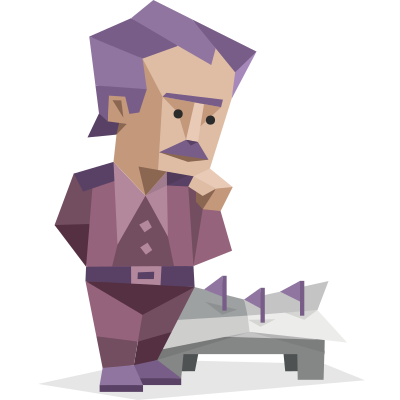
 personality type () presenting personality charts at an easel beside scientific equipment.

What about you?

Free

Only 10 minutes to get a “freakishly accurate” description of who you are and why you do things the way you do.

Take the Test

Introvert (I) Personality

Strength in Reserve

Introverts are well-suited to many situations. A tendency to be reserved helps these personality types to pace themselves. They’re likely to listen to others more carefully. Very introspective, Introverts enjoy more focused “alone time” – leading to more and deeper insights. And, while sometimes too sensitive to their environments, this often helps them pick up cues more quickly, making them great at reading many situations.

80% of Introverts say they often find that time spent alone is more interesting and satisfying than time spent with other people, compared to 29% of Extraverts.

However, this same reserve means that Introverts tend to find outside stimuli like noise, motion, or intrusive lighting frustrating. Some of this can be an invigorating change of pace – too much unsettles them and drains their energy. These personality types often prefer to be in their own space where they can adjust their environments. Add a human factor to this sensitivity – for example, insistent conversations where they’re expected to be just as insistent – and it can exhaust them. They need time alone to regather their energy and restore their calm.

People with this personality trait find strength in creating their own space.

Introverts’ reserved, more solitary nature presents challenges, as many societies favor Extraverts and their bolder approach. But it helps Introverted personality types to take things slowly, cautiously, and with less fanfare. Fortunately, if they’re willing – and create the time to recharge on their own – most Introverts can handle society’s strenuous demands.

In fact, many successful leaders and entertainers come from their ranks, often remaining humble and avoiding an unnecessary spotlight in fame. The Introversion personality trait never needs to disqualify those who possess it from pursuing a goal.

84% of Introverts would feel cautious, worried, or even downright horrified if they suddenly realized they were becoming famous, compared to 51% of Extraverts.

Extravert (E) Personality

The Power of Engagement

89% of Extraverts say they are comfortable verbally expressing gratitude when they feel it, compared to 67% of Introverts.

Extraverts are interested in engaging with their environment, and they feed off the responses of the people and events around them. They enjoy pushing limits and seeing what the world can do. This all depends on many other factors and life’s natural limitations, but Extraverted personality types lean toward taking the initiative and relying on the world around them for validation.

An idle Extravert is an Extravert looking for something to do.

While all of this is noble and often admired in society, it can also become unbridled. Extraverts may put too much value in their engagement with those around them. Being with others can be so important to these personalities that they often find it difficult if they’re stuck alone. Boredom comes too easily. This can lead them to do things simply for excitement rather than thinking through more subtle but important considerations. Becoming the center of attention – at any cost – might be too appealing.

87% of Extraverts believe they have what it takes to be a good leader, compared to 56% of Introverts.

However, when they suitably address these challenges, Extraverts are forces to be reckoned with. People with this personality trait tend to advance projects important to them quickly, whether personal or professional. They often choose to lead when given a chance – and can be dynamic in that role. Their outgoing energy can be vital to a social gathering, and their liveliness can be contagious. And there always remains a sense that people are important to them.

Comments

Please to join the discussion.

ENFP avatar
Finally, someone understands that it's not JUST about extrovert is talkative and introvert is quiet! I'm an extrovert but my friend is an introvert and everyone thinks that she's just "quiet" but she's really outgoing when with me. It's really hard for her to talk with others, but there's also other aspects such as she doesn't feel she can be a great leader (but I know she can), and she much prefers calmer holidays. I'm glad that this article also provides statistics instead of just saying things without proof. Thanks, 16 Personalities!
ENFP avatar
You must be someone she can completely trust and be safe with
INFJ avatar
Yeah, for me It's the other way around. I'm an Introvert, but I struggle to keep my mouth shut, even though I talk quietly. I'm also a great leader, and actor. (I know right... SOOOO humble) ;)
INTJ avatar
Glad to know there are some statistics involved. I really appreciate these articles!
INTP avatar
This is great.
INFJ avatar
This is a really good article because as a INFJ-T ,I am very introverted so thanks.
INFJ avatar
I love how this reflects that not all introverts are necessarily unsocial. If I know you I can be super talkative and bold, but if I don't know you, am in a new environment, or don't have my safe people with me then forget it
ISTP avatar
You read my mind!
INTP avatar
I know! I'm a huge chatterbox with my friends, but I am so socially awkward any other time.
ENFP avatar
That's so true though! Even though I am an extrovert, if I haven't talked to you before I am really nervous, haha. The only reason I'm able to make new friends is my talkative energy, so people talk to me first then I feel comfortable. But ask me to strike up a conversation with someone? Way too scared for that!