
ISFJ personalities (Defenders) are Feeling types – but they’re the only one in our “Head vs. Heart” survey to say they lead with their head. Their care is real. It just doesn’t look the way you might expect.
What’s Coming Up
- Key Takeaways
- The Only Feeling Type That Leads With Logic
- How Do ISFJs Compare to Other Feeling Types?
- How the Observant and Judging Traits Shape ISFJ Emotion
- How the ISFJ Way of Feeling Shows Up in Everyday Life
- Frequently Asked Questions
- Further Reading
Key Takeaways
- On nearly every measure of emotional expressiveness, ISFJs rank differently from other Feeling personality types. This is not because they feel less, but because their emotions are less likely to dominate their decision-making process.
- ISFJs are the Feeling type most likely to find it hard to relate to emotionally expressive people, and the most likely to say their decisions have clear rational reasons. The Observant and Judging traits shape the ISFJ emotional experience in ways that can look like logic from the outside.
- ISFJs’ emotional language is less verbal and expressive in a conventional sense. Instead, it’s practical, consistent, and specific – ISFJs remember, they anticipate, and they act.
- Understanding how ISFJs express care matters for anyone close to one. They give a great deal, and they rarely ask for the same in return.
The Only Feeling Type That Leads With Logic
ISFJs are the only Feeling personality type to lean toward logic over emotion when making decisions – but anyone who knows one can confirm the depth of care behind those choices. They remember offhand comments from months ago, notice when you seem off before you’ve said anything, and reliably appear when they’re needed (and often before) – without being asked.
In our “Head vs. Heart” survey – where over 31,000 respondents told us about how they experience logic and emotion – ISFJs turned out to be an outlier in their own group. They’re the only Feeling type in the survey to lean toward a more logical approach to life over a heart-led one.
There’s no question that ISFJs are solidly on the Feeling side of the Thinking vs. Feeling divide – so why is it that the way they feel differs so much from others with the same trait? Let’s explore the survey data to find out why.
How Do ISFJs Compare to Other Feeling Types?
Only 47% of ISFJs say they follow their heart over their head when making important choices – the lowest rate of any Feeling type in our survey. Every other Feeling type came in above 50%.
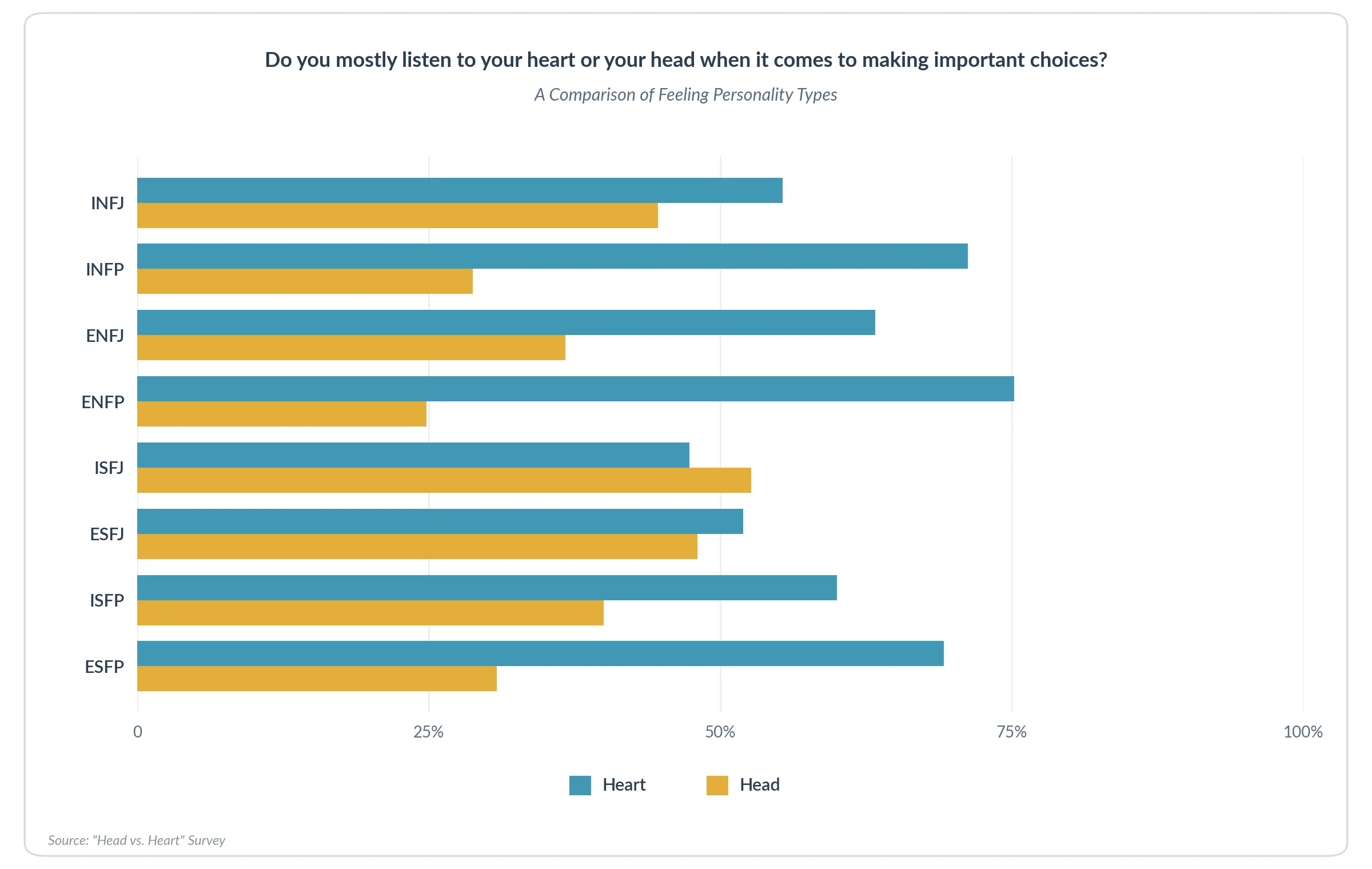
The gap between ISFJs and the next-closest Feeling type is 5 points. The gap between ISFJs and the most heart-led type – ENFP personalities (Campaigners) – is 28 points.
In the survey, ISFJs stand out as outliers among Feeling types on several questions:
- 57% of ISFJs say their actions and decisions always have clear rational reasons behind them – much higher than the 35% average for all Feeling types.
- 37% of ISFJs say that they often talk about their own feelings and emotions – below the 48% average of all Feeling types.
- 36% of ISFJs say they let themselves cry in front of others – below the 42% average of all Feeling types.
- 35% of ISFJs say they find it hard to relate to people who let their emotions guide them – much higher than the 21% average of all Feeling types.
The data paints a clear picture of a Feeling personality type that doesn’t always wear their feelings on their sleeve.
How the Observant and Judging Traits Shape ISFJ Emotion
ISFJs share the Feeling trait with seven other personality types. What defines their experience is the combination of the Observant and Judging traits alongside it.
The Observant trait grounds ISFJ personality types in the present moment. They tend to focus on their concrete reality rather than abstract ideals. ISFJs don’t process their emotions by building a grand narrative or focusing on big-picture outcomes – they process them by channeling their energy to what’s in front of them.
The Judging trait routes experience through established frameworks and past precedent. When it comes to dealing with the emotional experiences of life, ISFJs draw on what has worked before and what seems most likely to work again. From the outside, this can look like a firmly rational approach, but it’s better understood as practical wisdom than cold analysis.
Together, these two traits channel the ISFJ’s Feeling tendencies away from expressive emotional processing and toward service-based, consistent, action-oriented care. The result doesn’t look like the visible emotional expressiveness of other Feeling types – it looks like loyalty, attentiveness, and practical care, offered steadily to the people in an ISFJ’s life.
How the ISFJ Way of Feeling Shows Up in Everyday Life
If you’re an ISFJ reading this, none of this is news. You already know that you aren’t the type of person to make a radical career change because you just “felt” there was something better waiting for you, or to randomly announce your feelings at the dinner table. You also know that you feel plenty – just in a way that can be hard to describe.
You feel more through action than through words. Your emotional intelligence looks a lot like paying attention. Call it logic if you want, but just keep doing what you’ve always done. Anyone paying close enough attention knows exactly what it means.

Comments
Please to join the discussion.