Identity: Assertive (-A) vs. Turbulent (-T)

Confidence, Achievement, and You

The Identity scale, made up of the Assertive and Turbulent personality traits, affects all other scales and indicates how confident we are in our abilities and decisions. Identity triggers the way we react to the things life constantly throws at us. How do we respond to success and failure? Criticism or feedback from other people? Unexpected events that suddenly change many things or everything? Even the unknown future?

79% of those with the Turbulent trait say they think a lot about their regrets, compared to 42% of those with the Assertive trait.

The Energy (Introversion and Extraversion) and Identity scales bookend our personality model. Together, they influence how we interact with our environments, including the people and the tasks within them. We call the four possible combinations of the two scales “Strategies” and you can find out more about them in the main theoretical article. But for now, let’s explore what the Identity scale looks like.

What about you?

What about you?

Free

Only 10 minutes to get a “freakishly accurate” description of who you are and why you do things the way you do.

Take the Test

Assertive (-A) Personality

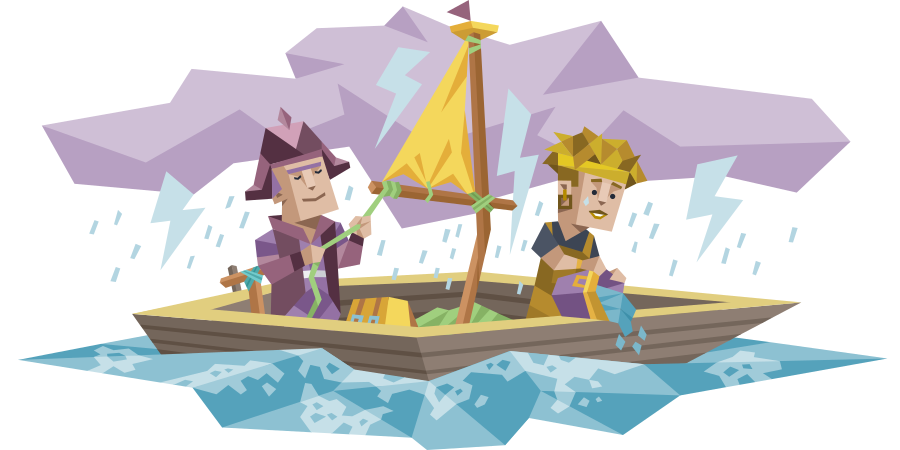
Calm in the Storm

93% of those with the Assertive Identity say they feel confident facing day-to-day difficulties, compared to 62% of those with the Turbulent Identity.

Assertive individuals are self-assured, even-tempered, and resistant to stress. They don’t worry too much, but this is different from apathy. They aim for goals and want successful results, but they typically won’t let nervousness color the path to their accomplishments. They’re unlikely to spend a lot of time thinking about their past actions or choices. According to Assertive personality types, what’s done is done.

Assertive personality types learn lessons from their personal histories, but they see little purpose in entertaining the same regrets again and again.

However, problems may arise for them if their confidence turns into overconfidence. Assertive individuals may gloss over problems or details that can interfere with their goals and desired results. They may lean toward assuming all will be positive. Assertive people also sometimes presume they are free to do much more than others would allow or tolerate. If overconfident, these personality types may come to believe their confidence overshadows what others want.

94% of those with the Assertive Identity say they have a healthy ego, compared to 58% of those with the Turbulent Identity.

But their confidence remains. It can help them move forward where others might hesitate. People with this personality trait report more satisfaction with their lives. They feel more assured of their abilities to handle the difficult and the unexpected. Through this lens, they often create the kinds of success that matter to them.

Turbulent (-T) Personality

Power of Stress, Activate!

Turbulent individuals are success-driven, perfectionistic, and eager to improve. They are always trying to counterbalance their self-doubts by achieving more. Just as they push themselves to become better, they’re as likely to push their projects or efforts in the same direction. Turbulent personality types tend to notice little problems and often do something about them before they become larger ones.

86% of those with the Turbulent Identity say that comparing themselves to others usually results in a negative feeling, compared to 58% of those with the Assertive Identity.

There are potential downsides to all this attention and achievement. Always feeling the need to do more, to have more, and to be more, Turbulent individuals can also get caught up in endless thoughts of criticisms, slights, or regrets. This can either bog them down or motivate them to do better. Their sensitivity to potential problems can be useful – unless that’s all they think about and the problems clutter their attention. Turbulent personality types may compulsively scan for what might go wrong instead of keeping their eyes on more positive targets – on what could go right.

Stress may have a bad reputation, but Turbulent types around the world show just how powerful a motivator it can be.

Careful and attentive people are always important to society and keep it safe. At the same time, a fear of stagnation can bring about great change. Turbulent individuals beautifully cover both. When these personalities balance their worries and concerns with positive action, they’re likely to prove themselves to be of great value.

Comments

Please to join the discussion.

A grayscale avatar for an anonymous user
I'm pretty split with this. I'm 56% turbulent and 44% assertive. I feel that internally, I'm pretty turbulent, but since everyone at my school seems to have no motivation to do anything worthwhile in their lives, I can feel a bit cocky from that.
A grayscale avatar for an anonymous user
I'm 56% assertive and 44% turbulent, the complete opposite of you lol. But, since I'm an INFJ, I'm more aware of myself I'm able to whip myself in shape. What is done is done, yes, but it's better to learn from the past and not forget it. I enrolled in a medical program in school while everyone else was indecisive, so I can agree with you on feeling cocky, like "ha, I'm better off than those people" ^ ^
A grayscale avatar for an anonymous user
ENFP here. And 74% turbulent. Never in my life have I read more accurate statements about my personality and my life than I have on this site. "Always feeling the need to do more, to have more, and to be more" is exactly right.
A grayscale avatar for an anonymous user
I'm ENFP-T too! :D Also, same about the "Always feeling the need to do more, to have more, and to be more" being completely right!
A grayscale avatar for an anonymous user
56% Turbulent... So that's why I feel empty inside when I run out of things to do on my tasks list...
A grayscale avatar for an anonymous user
I think that it’s probably the Prospecting side of you that feels bored, but I’m not too sure! Isn’t the A/T trait for stress resistance?
A grayscale avatar for an anonymous user
Pretty sure it's how we react under stress, but also how we feel about task completion and overwhelming responsibilities.
A grayscale avatar for an anonymous user
100% turbulent ha no wonder I have stress issues
A grayscale avatar for an anonymous user
Here is your friend. 92% turbulent and trying to work around mental health challenges.
INTJ avatar
Same
INTJ avatar
51% Turbulent. . . pretty much explains various things about me. -AM.S. Architect